How to Draw a Lighting Plan Interior Design
Nosotros're the start to admit that up until a few years ago, nosotros were completely clueless when it came to lighting. However the more nosotros learn about design, the more obvious it becomes how important it is to have a well-considered lighting programme. Whether you're simply renovating a zone of your home, undertaking a new build, or even a larger project, go on on reading for skillful tips from Illumination Scientist and owner of Luxygen, James Nagel. He has defended his career to lighting and is i of the few people in Australia who comes so highly qualified to talk on the subject.
Related commodity: What height to hang pendant lights?
Related article: Light locations in a new home? Good communication on the dos and don'ts
Up until recently we hadn't heard the term 'lighting program', tell us what these are and why they are then important.
"Quite but, a lighting programme details what types of lights and how many you will have in each zone. By and large, I'll work from a floor program to specify what lighting would be placed where.
The important objective in creating a skillful lighting plan for your home is agreement the role of each room. This way y'all can consider tasks performed in a space and provide functional and artistic lighting.
"There are three basic layers of lighting — job, ambient and accent — and each type meets a particular need," says James.
Can you explain more about that?
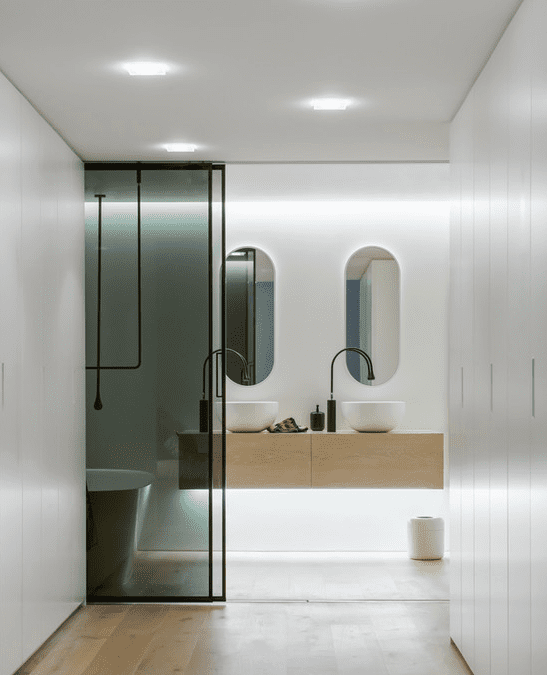
"I ever start with task lighting, which means considering spaces that require specific functional lighting, some examples might include above a kitchen bench, at face level at the bathroom mirror, over desks surfaces or reading areas, and in cupboards.
"And so I consider ambience lighting, which is the overall illumination of an area. It should create visual condolement. Consider lighting ceilings and walls, a softly illuminated wall can often be a amend approach than a bunch of downlights in a room.
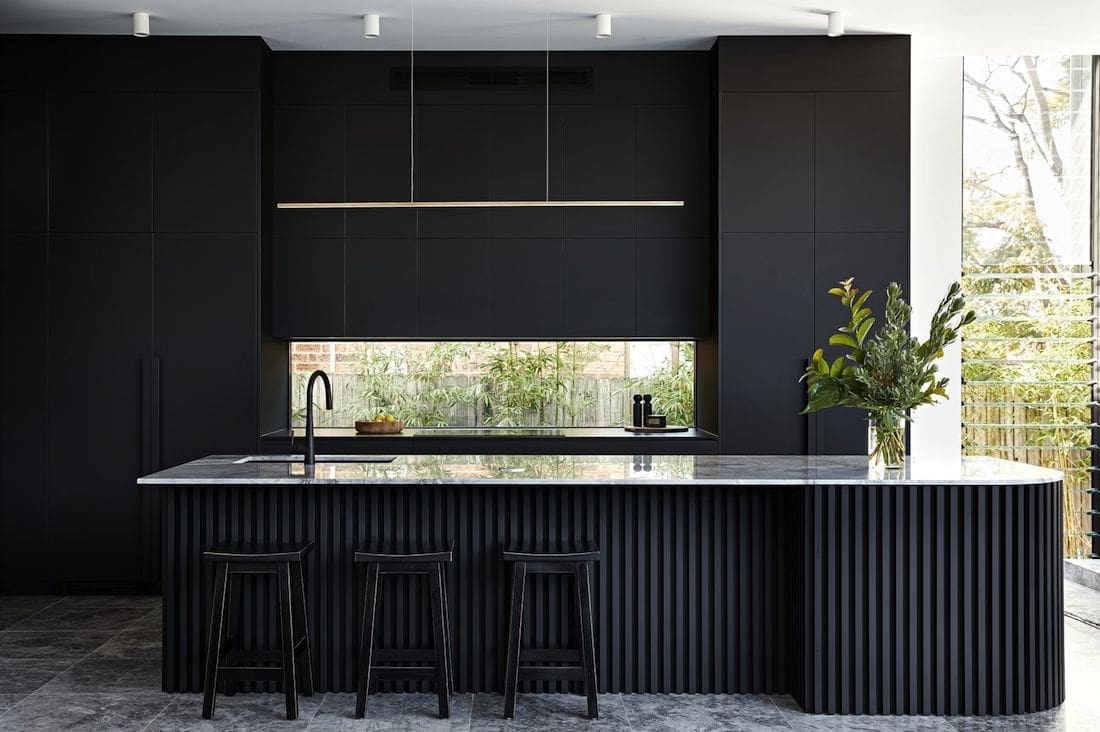
"The apply of uplighting on a clean ceiling allowing the light to reflect is probably the best way in my view of achieving ambient lighting. For case, a pendant over a kitchen bench with both direct and indirect lighting would achieve both.
The terminal layer of lighting is accent, which adds creativity to a room.
"It draws the eye to the visual statements and allows you to get creative. Some examples might be highlighting a painting or a textured wall, or adding some colour such as lighting a tree with greenish lite."
What are the biggest mistakes you see when it comes to residential lighting?
"More often than not when people build a firm, they run out of coin past the time it comes to lighting and landscaping.
Many people end up just filling their houses with downlights. I estimate it works, but it'southward not very artistic — you by and large take over-lit spaces and not a lot of visual interest.
"Oft people don't consider the space well enough before they select their lights. Understanding the part of the room is important. Placement of furniture and even reflections from surfaces similar mirrors should besides be considered. And too often nosotros use too much artificial light."
Here are James' meridian 5 tips to designing your lighting program:
1. Describe a floor programme
James says the kickoff step is to draw a flooring programme of the surface area you will be lighting. Make it to calibration and include detailed information like window and door positioning, and furniture placement.
This fashion you'll have a true sense of the area you're working with and tin more hands determine where your lighting should exist positioned and how many to include. For instance, you don't need the aforementioned spread of downlight across your full living room, rather you lot may like to accept 2-iv above your sofa (depending on its size) so yous tin illuminate the area you will be sitting and utilise less elsewhere. Similarly, on walls where you know you lot will hang artwork, you can use two wall washers (prepare closer to the wall) to illuminate artwork.
2. Think about the tasks
Before deciding on any type of lighting, you lot need to first ask yourself 'What will you be using the infinite for?'. Lighting is beginning and foremost functional and y'all demand to empathise how yous will utilize a space before deciding how much and what type of lighting you lot will need. You might like to mark a small ten over the areas you need task lighting.
3. Add ambience and accent lighting
One time functional lighting has been locked in, y'all tin can get onto the fun part of adding ambient and accent lighting. Retrieve pendant lights, decorative wall lights, LED track lighting, upwards lights, wall washers, table and floor lamps. Consider all lighting surfaces like walls and the ceiling. At this stage you're still just designing where you want light.
four. Define a budget
The cost of lighting can vary A LOT! Every bit before long every bit yous wait beyond mass-produced lighting, you tin commencement adding zeros to the stop of the amount you think it should cost.
Don't be disheartened though, it's still possible to reach a fabled outcome with various budgets. Our tip is to create a mood board for your space or new dwelling house build, and get clear on the await you lot want to accomplish. This will aid you to identify the manner of lighting that would suit and and so the researching can begin! You can observe salvage vs splurge versions of most lights on the market to accomplish the look you want within your budget.
5. Select luminaires (aka light fittings)
Once you know the type of lighting you need and how many, and what your budget is, you tin can now become onto the fun function of selecting the lite fittings! While the temptation is to oft make a statement with lighting, James reminds the states that "It'southward not always the luminaire that should be the standout element of the infinite".
There you have information technology! There's more than to lighting than simply deciding how many downlights to put in each room.
While it's oft forgotten about, lighting can have a profound effect on the look and feel of a home. Hopefully these practical tips are helpful when you lot build or renovate your abode. Practise you have more lighting tips? Share them beneath!
Check out more than lighting articles
This article was first published in May 2015 and has been updated with new data and images.
Source: https://stylecurator.com.au/how-to-design-a-lighting-plan-for-your-home-learn-the-3-types-of-lighting/
0 Response to "How to Draw a Lighting Plan Interior Design"
Post a Comment